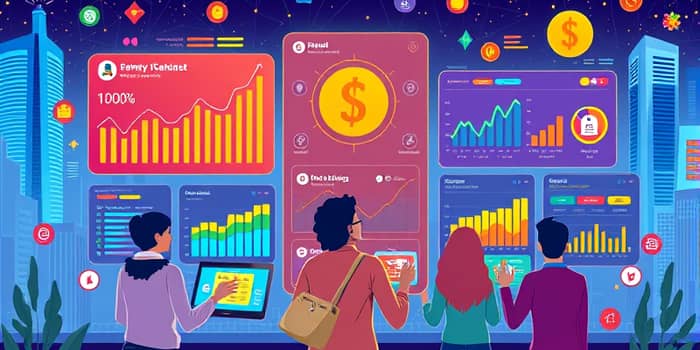
As financial products evolve, banks and fintech companies are turning to innovative strategies to capture attention and drive better outcomes. Gamification, the infusion of game-like features into financial services, is reshaping the way people save, invest, and manage money. By leveraging elements such as challenges, badges, and progress bars, institutions can foster engagement, deepen learning, and ultimately encourage healthier financial habits.
The core idea behind gamification is simple: make routine or complex tasks more enjoyable. In a financial context, users encounter a range of interactive features that motivate action and sustain interest over time. Points, rewards, and streak-based challenges align everyday financial behaviors—deposits, bill payments, and budgeting—with game mechanics users already find compelling.
Financial platforms integrate interactive storytelling, simulation tools, and visual progress tracking to deliver engaging and interactive financial experiences. Whether building a virtual city linked to spending data or unlocking achievement badges for completing savings goals, these features transform abstract numbers into tangible milestones.
The gamification market in finance was valued at $9.10 billion in 2020 and is projected to surpass $30.70 billion by 2025. Other estimates extend even further to $48.72 billion by 2028 as adoption accelerates across digital-first and traditional institutions alike. Early adopters report dramatic uplifts in key metrics.
For example, Extraco Bank in the United States saw a 700% increase in customer acquisitions after gamifying its education programs. Conversion rates climbed from 2% to 14%, while user engagement rose by nearly 48%. Financial apps with gamified savings features boast average savings increases of 20%, with systematic savings behaviors growing by 22%.
Gamification leverages well-established behavioral psychology principles. Positive reinforcement through points and rewards builds momentum, while streaks and challenges create a sense of progress and achievement. Leaderboards and social sharing tap into friendly competition, further boosting motivation.
By turning financial tasks into interactive missions, platforms establish personalized and motivating reward mechanisms. Users receive immediate feedback when they complete a task, reinforcing the desired behavior and making the next action feel more approachable. Over time, these behavioral loops can foster sustainable positive financial behaviors, embedding good habits in daily routines.
While gamification offers remarkable benefits, it also raises concerns. Over-gamification can trivialize important financial decisions or foster addictive behaviors if not carefully managed. Designers must ensure that game mechanics nudge users toward genuinely beneficial actions rather than engagement for its own sake.
Transparency and data privacy are paramount. Users should clearly understand how their data is used and how reward structures operate. Banks and fintechs must adhere to strict data protection standards while leveraging personalization to deliver tailored experiences.
Emerging technologies, particularly artificial intelligence and advanced analytics, promise even more sophisticated gamified experiences. AI-driven personalization will enable micro-adjustments of challenges and incentives based on real-time behavior patterns and emotional cues. Financial institutions will increasingly blend health and wealth gamification, creating holistic wellness ecosystems.
As traditional banks adopt these strategies to remain competitive, we can expect deeper integration of gamification across lending, insurance, and retirement planning. Interactive retirement simulators will demystify long-term financial decisions, while insurance apps might employ game mechanics to reward healthy lifestyles and safe driving habits.
The gamification of finance represents a transformative shift in how institutions engage users and promote positive financial behaviors. By embedding game elements such as progress tracking, challenges, and rewards into everyday financial tasks, platforms can deliver engaging and interactive financial experiences that educate, motivate, and retain customers.
For financial professionals and product designers, the imperative is clear: harness the power of gamification responsibly. By focusing on transparent mechanics, ethical design, and constant iteration, the industry can unlock new opportunities to empower users on their financial journeys. Gamification is not just a trend—it is a strategic pathway to a more inclusive, engaging, and effective financial ecosystem.
References