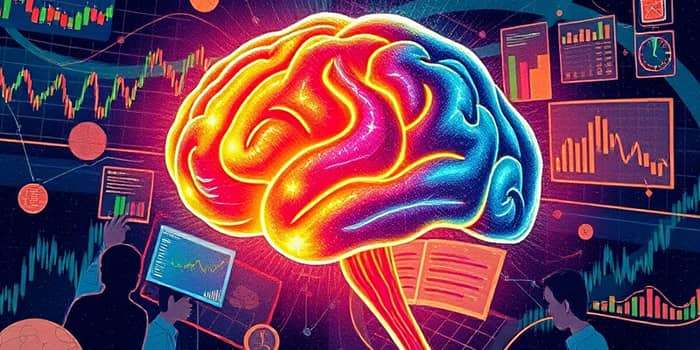
Neurofinance has emerged as an interdisciplinary field combining neuroscience and finance, aiming to decode the hidden neural patterns that shape market behavior and individual trading choices.
At its core, neurofinance investigates how emotions, brain processes, and cognitive biases drive investment decisions. Unlike traditional behavioral finance, it leverages advanced tools such as functional magnetic resonance imaging (fMRI) and electroencephalography (EEG) to observe traders’ brains in action.
The field first gained momentum in the early 2000s, when technological advances allowed researchers to correlate neural signals with real economic choices. Today, it stands at the forefront of financial innovation, offering both theoretical insights and practical applications for individual investors and institutions alike.
Neurofinance research pursues several primary objectives, each aimed at enhancing the reliability and performance of decision-making under uncertainty.
To achieve these goals, scientists employ a mix of experimental and observational techniques. By combining neuroimaging (fMRI, EEG) and behavioral experiments, they track brain activation patterns while participants engage in simulated trading scenarios.
These methods yield rich datasets, enabling the identification of neural signatures tied to risk perception, reward anticipation, and emotional regulation.
Financial decision-making recruits a network of brain regions that process risk, reward, and emotion. Understanding this network helps explain why traders sometimes behave irrationally.
Key phenomena observed include:
Beyond neural circuits, traders grapple with well-known biases that skew judgments:
Heuristics simplify complex markets but introduce systematic errors. Confirmation bias drives selective information uptake, reinforcing existing beliefs. The disposition effect compels traders to sell winners too soon and cling to losers, while the endowment effect leads to overvaluing owned assets.
Emotions further color choices. Fear can trigger hasty sell-offs during market dips. Conversely, greed and hope inflate risk-taking during rallies. Frustration after losses and the euphoria of gains both shape future repurchase behaviors.
By harnessing neural insights, traders can design strategies that counteract their own weaknesses. For example, combining brain scans with questionnaires allows for personalized risk profiles, quantifying each individual’s risk tolerance and loss aversion.
Rule-based approaches, such as predefined exit points and rule-based trading, mitigate impulsive actions by enforcing discipline. Training programs that build emotional awareness through simulated trading and real-time feedback help traders recognize and manage stress-induced impulses.
Neuroscience experiments have illuminated several market phenomena. In price bubble studies, participants’ neural responses to rapid price changes predicted their likelihood of buying into overvalued assets. Another paradigm explored repurchase effects: scans revealed that regret-related circuits reactivated when investors considered rebuying previously sold stocks.
Comparative analyses between professional and amateur traders show distinct neural signatures. Seasoned professionals often exhibit stronger prefrontal engagement during decision-making, indicating superior emotion regulation and analytical control.
Neurofinance paves the way for personalized finance through neural profiling. Financial advisors could one day access clients’ risk metrics derived from neural data to tailor portfolios. Market prediction models incorporating collective neural biases may forecast short-term inefficiencies tied to mass emotional swings.
Trading platforms might evolve into neuroadaptive environments, monitoring biometric signals like heart rate and galvanic skin response, offering alerts when traders approach emotional overload. Such innovations promise to make markets more resilient and participants more self-aware.
The integration of brain data in finance raises significant ethical questions. Collecting sensitive neural information demands rigorous privacy safeguards to prevent misuse or unauthorized profiling. Traders must provide informed consent before their neuro-data is recorded or analyzed.
There is also a risk of manipulation: firms with privileged access to neural insights might exploit clients’ vulnerabilities. Establishing transparent governance and ethical standards will be crucial to ensure responsible use of neurofinance technologies.
Neurofinance stands at the crossroads of brain science and market strategy, offering unparalleled insights into the hidden drivers of financial behavior. By illuminating the neural underpinnings of risk, reward, and emotion, it empowers traders to overcome cognitive traps and make more informed decisions.
As research advances and ethical frameworks mature, neurofinance has the potential to revolutionize investing—transforming uncertainty into understanding and paving the way for a new era of psychologically informed market participation.